
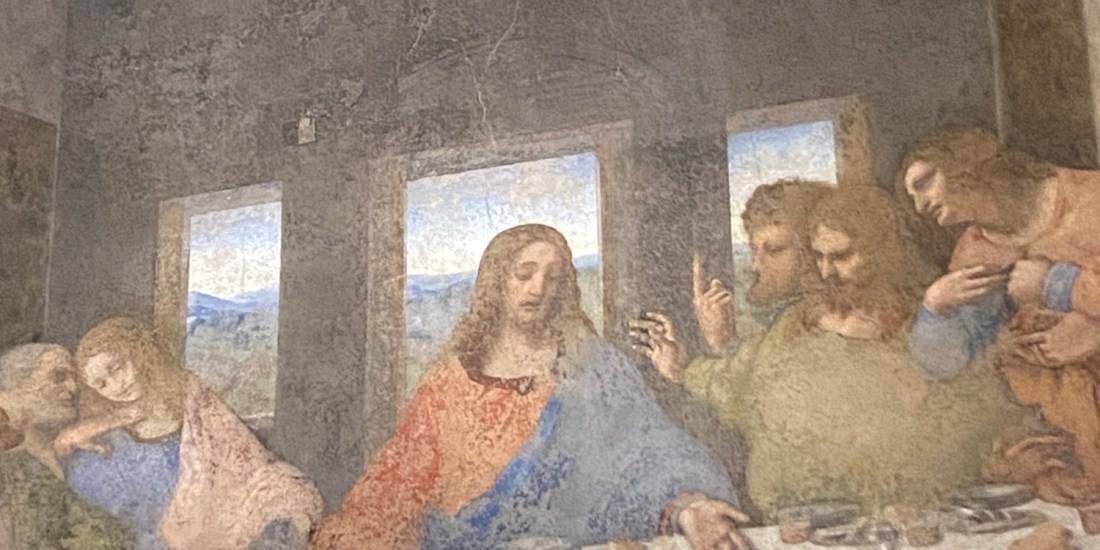
Leonardo da Vinci’s (1452-1519) Last Supper is arguably one of the most widely recognizable mealtime scenes in the history of art. It depicts a pivotal moment in the life of Jesus Christ that was widely understood and recognized long before Leonardo began his version between 1494-1498. The scene illustrates Christ, at center, breaking bread with his twelve Apostles during Passover. It depicts the moment, when Christ utters the words, “Very truly I tell you, one of you is going to betray me.” (John 13:21). Leonardo captures the mixture of emotions from the Apostles, flanked into groups of three on either side of their savior. Anguish, grief, determination, and shock are palpable as emotions swirl and the men attempt to discern who is the traitor in their midst.
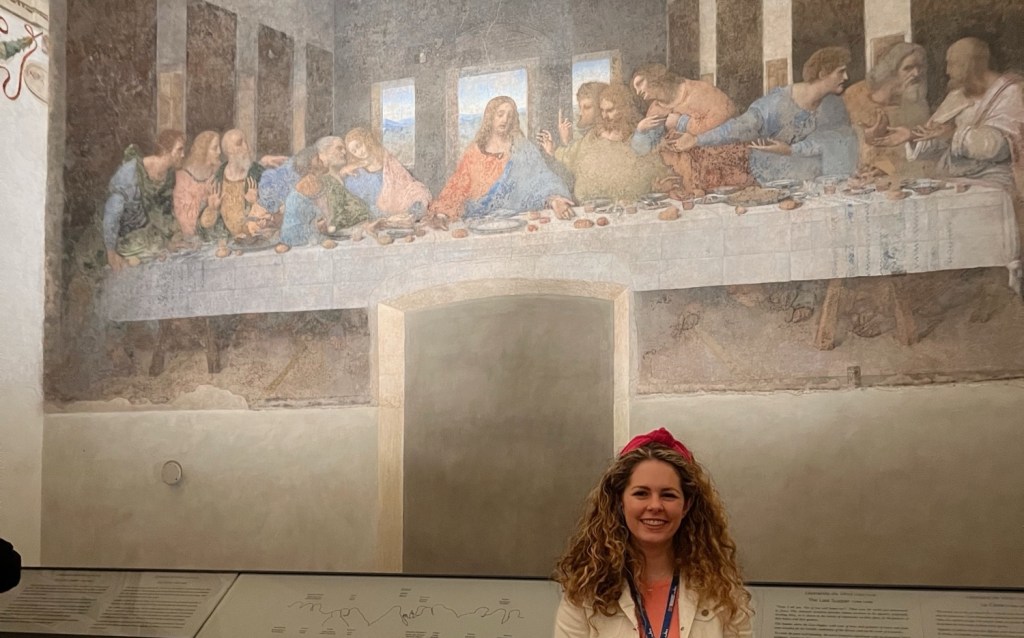
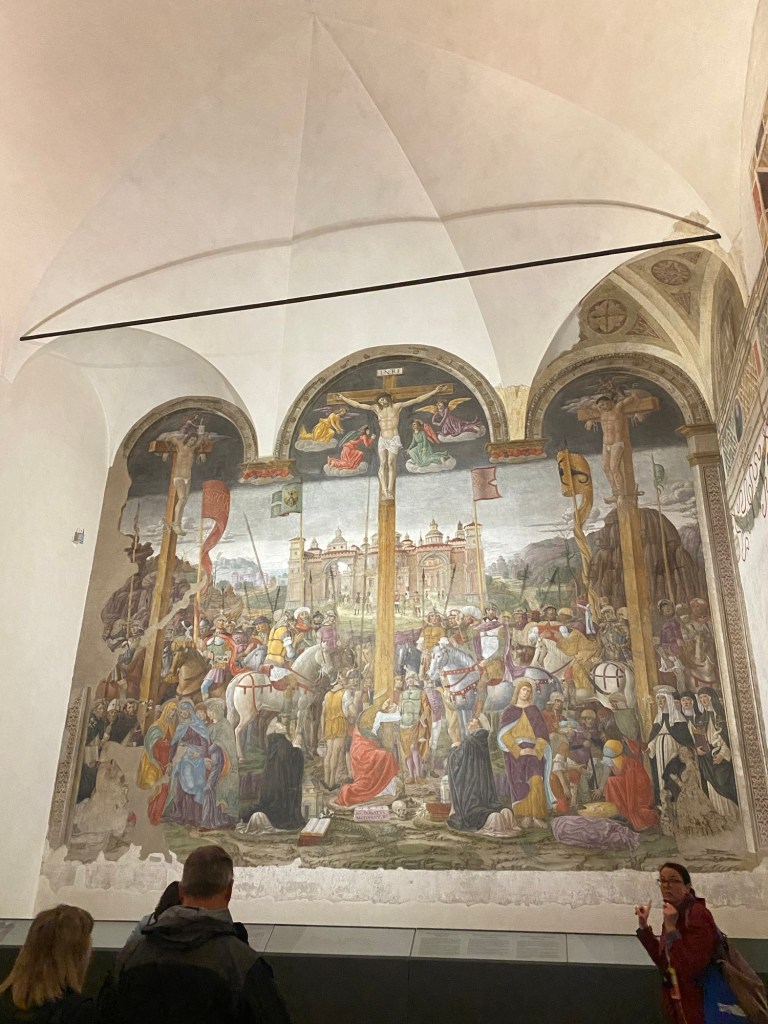
While planning a recent trip to Milan. I secured my “Open Table” reservation to see the work in person. The masterpiece is located on the northern wall in the refectory of Santa Maria delle Grazie. It is paralleled by Giovanni Donato da Montorfano’s fresco of the Crucifixion. In order to lock-in my time for this excursion (as the tickets sold out a few months in advance), I elected to partake in a guided, walking tour of the Duomo di Milano and some surrounding tourist sites. The tour company handled securing the reservation, but guests are responsible for bringing a form of government issued ID on the tour – visitors must show this documentation in order to receive their ticket at the Santa Maria delle Grazie.
The Last Supper is not a traditional fresco. The work is comprised of an experimental combination of oil paint and tempera that Leonardo placed on dry plaster. The artist wanted to have the option to tweak and refine the work and thought this medium would provide him with some level of flexibility. However, this exploratory technique did not protect the work over time, and it began to rapidly deteriorate. Other factors such as open windows, steam from food and using the mural for dart practice during the Napoleonic troops occupation contributed to the degradation. Most notably, during World War II, the ceiling collapsed in Santa Maria delle Grazie during the Allied bombing and led to substantial damage. Additionally, there were poor attempts by conservators that attempted to save the work, but ultimately, further altered the composition. Scholars claim the features and positioning of Peter, James the Less, Judas and Andrew were altered significantly by these attempts.
To visualize the true level of deterioration inherent in Leonardo’s technique, one need only walk to the south wall in Santa Maria delle Grazie and view the portraits in Donato Montorfano’s fresco of the Crucifixion. Scholars believe Leonardo added in the portraits near the lower left and right corners. What’s left in the year 2024 is a thin outline of the figures that is barely visible and presents a stark difference from the rest of the work,
From 1977-1999 Pinin Brambilla Barcilon led a groundbreaking conservation study that aimed to reverse the substantial changes to the Last Supper and restore it. The work was cleaned to address decades of pollution and dirt that accumulated on its surface. Repainted areas were removed, gaps were filled, and all efforts were made to restore original layers and pigments done in the hand of the High Renaissance master. Additionally, in order to refrain from moving the work, the aforementioned windows were sealed and Santa Maria delle Grazie invested in climatized chambers to further protect the work. Additionally, original sketches by Leonardo were consulted and compared to the figuration. Thus, only 20% of the work is deemed in the hands of Leonardo, and the rest is understood to be handled by conservation efforts.

Visitors are only allowed fifteen minutes with the Last Supper. Before walking into the climate-controlled chamber, guests wait outside and are greeted by timelines and other informational placards detailing the rich history of the piece. Nothing prepared me for the walk into the cold room to view awe-inspiring Last Supper in person.
Viewing the Last Supper has always been on my Catholic bucket list – but I was blown away by seeing it in person. I almost felt guilty briefly gliding over to view Donato Montorfano’s Crucifixion. My main takeaway is I could not fathom how large it is! It consumes the north wall at 180 x 350 in. Additionally, it is not behind glass – meaning, viewers can get up close and personal with the work and do not have to worry about a glare. A thin, metal bar creates a border of separation between visitors and the work, but aside from that, guests have free roam in the space. I tried to take in each grouping of figures, spending a considerable amount of time with Judas, Peter and John. In this grouping, there are several key props, such as Peter’s sword, and Judas’s bag of silver that illuminate the drama of the scene. Additionally, pausing to look at Simon, located on the far right, who has suffered the most damage. His face is barely discernible on the wall due to the experimental technique and the bombing during World War II. The windows behind the figures act as a perspective device and add a layer of depth and brightness into the work.
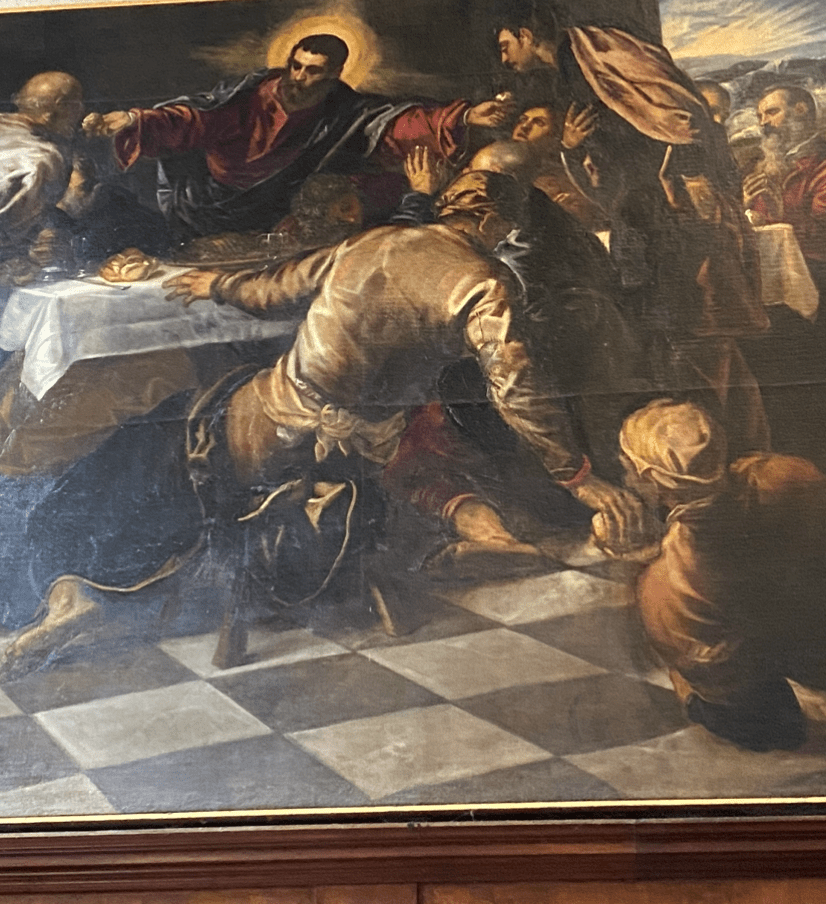
On this trip, I had the opportunity to view other Last Supper scenes, such as Jacopo Tintoretto’s (1518-1594) in the Church of San Polo. Tintoretto’s scenes are imbued with drama and animacy. Whereas Leonardo opted for a snapshot of stillness, the oil produced circa 1590 drastically shifts the viewer’s perspective and encapsulates the movement of the figures. Here, Christ stands up and thrusts his hands in between his Apostles. On the far left, Judas is seen with shoes, grabbing the pouch of silver and heading for the door. While both Leonardo and Tintoretto chose to portray the same event, these varying moments, arguably separated by seconds, enable a drastically different composition that is common in the Last Supper’s visual culture.
Categories: #marysmusings, arthistory

 marysmusings.art